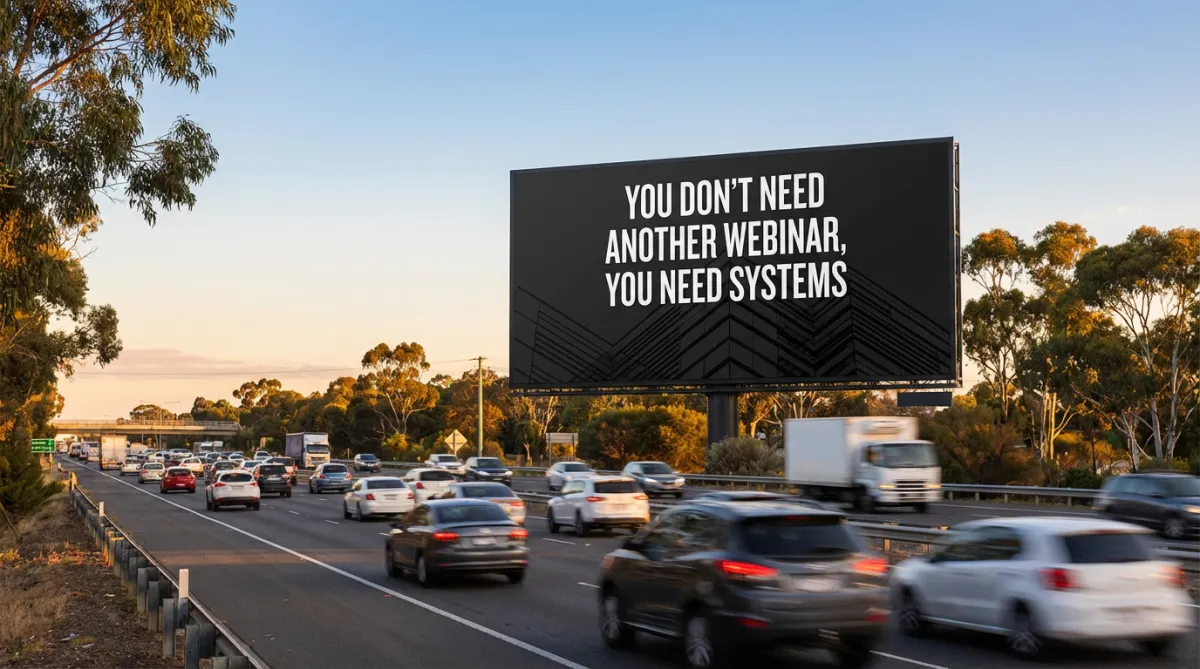
You Don't Need Another Webinar, You Need Systems
I’ve got a mate who's a tradie, and we were having a gasbag at a BBQ recently when he mentioned he was thinking about selling his business.
I told him you can't sell your business when it's just you… You are the business, amigo. Without you, there is no business.
He looked at me like I'd just kicked his dog.

I’ve had a version of this convo with a heap of other business owners too. They're stressed, they're trapped, and they're spending heaps on these random internet coaches or programs that promise them the world while suspiciously avoiding the one thing that would actually set them free.
Systems.
The Mentoring Complex
Here's what I see happening.
A business owner is turning over a couple of million dollars a year. They're knackered. They see some schmick business influencer on Instagram - you know the ones, all cigars and cars and "scale your freedom" talk.
So they sign up. They attend the webinars. They join the community. They feel productive for a bit.
But six months later...
They're still the one who has to be involved in every single quote.
They still can't take a holiday without their phone blowing up.
They still don't know how many leads they actually need each month to hit their numbers.
Because that random internet coach never asked them to build the boring infrastructure that would actually return their time.
Research shows that mentored small businesses have a 70% survival rate - double the rate of the ones without mentoring support.
That's the power of a good mentor, and I'm 100% on board with that.
What They're Actually Avoiding
I think business owners bounce from webinar to webinar, programme to programme, because it feels like progress.
But it doesn't require them to actually confront the hard truth - their business is completely dependent on them being there. They're the roadblock!
Building systems means admitting that. It means looking at how much of your business exists only in your head. The things you do automatically. The knowledge you take for granted. The processes you've never written down because you've always just done them.
That's uncomfortable work, and it's super easy to put it off.
48% of small business owners have dealt with burnout in the past year. And I reckon a big chunk of that comes from being the single point of failure in their own business - unable to step away, unable to delegate, unable to take a shit without everything falling apart.
It's way easier to pay for another workshop on mindset or scaling or whatever the current trend is.
I have raging ADHD, so I get task avoidance. Deeply. Prime example is I'm writing this because I'm putting off somethign else.
I've spent literal days trying to find the perfect productivity app when I could have just done the actual fucking work.
What I learnt was that the problem wasn't the tools. The problem was me avoiding the thing I knew I needed to do.
What Do Systems Actually Look Like - The Lead Exercise
When I talk about systems, I'm not talking about fancy schmancy software or complex automation.
I'm talking about the minimum viable infrastructure that lets your business run without you, or someone else, being the single point of failure.
A good place to start with is leads. And let's do this as a mini-exercise, so get your thinking hat on buckaroo.
Woahhhh Nelly. What actually IS a lead?
A lead is a person who’s raised their hand and shown a bit of interest in what you do. They’re not a customer yet, and they’re at the very start of the journey.
It usually happens when someone gives you their details, like an email or phone number, because they’ve downloaded something, filled out a form, booked a call/meeting, or asked a question.
From there, your job is to stay in touch, build trust, and help them decide whether working with you actually makes sense for them.
I want to you actually answer each of the below. Pens out, kiddlettes!
1 - Work out what a lead is for your business.
Is it someone filling out a form for a quote on your website?
A text message enquiry?
A phone call?
An email?
An Insta DM?
2 - What makes a lead qualified versus unqualified?
Not every lead is created equal, and that’s totally normal.
A qualified lead is someone who actually has a problem you can help with, is roughly the right fit for what you offer, and is realistically able and willing to do something about it. They might not be ready to buy today, but there’s potential there.
An unqualified lead is someone who might be curious, price shopping, not have the budget right now, isn't a good fit, or not in a position to do it now. That doesn’t mean they’re bad or time wasters - it just means they’re not a good match right now.
Remember - the goal isn’t to judge. It’s to be realistic about who you can actually help and who's likely to turn into a paying customer.
3 - What do you need to make to be profitable? AKA your revenue target
This is where a lot of business owners get stuck, because no one ever explains it properly.
Your revenue target is how much money your business needs to bring in to be worth running. Not just to survive, but to pay you properly and cover your costs.
That includes things like:
➡️Paying yourself a fair wage
➡️Covering your business expenses
➡️Paying tax and super (and holidays and sick leave, even for yourself)
➡️Allowing some breathing room - not just scraping by
You don’t need to overcomplicate this if you're doing it for the first time, but a spreadsheet will def help. Start by asking yourself “How much do I need this business to make each month so I’m not stressed and it actually supports my life?”
That number is your starting point. It’s not about being greedy, it’s about being sustainable.
4 - How many leads do you need a month to hit your revenue target?
Once you know your revenue target, this part becomes a heap clearer. Think about:
➡️ On average, how much does one customer pay you?
➡️ Roughly how many leads turn into actual customers?
For example, if you need $10,000 a month and your average customer pays $2,000, you need about five customers. If one out of every five leads becomes a customer, you’d need around 25 leads a month.
These don’t have to be perfect numbers. Estimates are fine for now. The point is to understand the relationship between leads, customers, and money.
This is what turns marketing from “I hope this works” into “I know what I’m aiming for”. Once you know how many leads you actually need, you can stop guessing and start making decisions that move the needle 🕺
Don't Be Sad!
Most of the business owners I work with can't answer these questions straight off the bat, and that's okay! That's what you're here to change.
Most small businesses have been running on organic growth and gut feel.
That works until it doesn't.
If you've got a team, what would happen (or has happened, more likely) when someone who's been with you for years and does everything - invoicing, admin, Christmas cards, all that jazz - goes on leave? Or if they quit. Or join some weird yoga cult in Byron.
If that thought gives you the nervous shits, you've got a problem.
You're first step to fix it? Get that person to write their own manual.
Not you. Them.
They know the role. You don't.
I always get pushback on this. Business owners want to write it themselves. They think they should know every role in their business. But unless someone's brand spankin’ new, the person doing the job knows it better than you do.
But here's the real winner - when you get people to document their roles, you often discover that two people think they do the same thing. Or someone's doing work that should belong to someone else. There's massive room for growth in that clarity.
The Bus Test
I tell just about every business owner who has employees to do this exercise.
Think about each person in your business. If that person got hit by a bus (or went on leave, whatever... the bus thing is more fun), would your business suffer?
If the answer is yes, you need to fix it.
Create an operations manual for each role. It doesn't need to be fancy. It just needs to exist.
Because right now, your business knowledge lives in people's heads. When they leave, that knowledge walks out the door with them. When you want to grow, you can't - because there's no way to transfer what they know to someone new.
Here's the real kick in the nads. Research on business process documentation shows that only 3% of knowledge workers are satisfied with their company's document handling process. Yet 77% of businesses are expanding their use of document management software.
The gap between knowing you should document and actually doing it? That's where businesses stay trapped.
Why Good Mentors Talk About Systems
I want to be super clear about something - I've got nothing against good mentors.
I've worked with some AMAZING mentors myself on specific things like financial literacy. My dumbass neurospicy brain is shit with numbers, and they helped me grow in areas where I genuinely needed outside expertise.
If you’re in the stage of business where systems feel foreign or a bit daunting, a good mentor will tell you to set up systems. They'll push you to build the infrastructure that makes your business work without you. Because once you have that foundation, you can start talking about big-picture strategy and future growth. The really fun stuff.
But the Instagram influencer types running cult-like programmes?
They don't see you as a person. You're a number in their paid Skool group or monthly group coaching calls (that always seem to have some sort of upsell offer at the end... hmmm, odd that). They're not invested in your actual freedom because your dependency is their business model.
Mind you, there are some amazing group coaches/mentors, or subscription/recurring type programs. I was a part of an office hours marketing coaching group, where small business owners paid something like 40 bucks a month, and they got to digitally drop in during certain hours and ask marketing experts specific questions about their business. It was really valuable and actional takeaways they got, and saved them spending hours Googling at night trying to find an answer.
If your mentor insists you need to run everything by them, or keeps selling you the next programme, or makes you feel like you can't succeed without their ongoing guidance - they're a con artist.
Fuck them RIGHT off.
The Real Question
Ask yourself this - what's stopping you from doing the work you need to do?
If it's a lack of knowledge or skills, work out how to get them. Maybe that's a one-on-one mentor who's a good fit. Maybe it's a focused two-day course on a specific subject. Or maybe you’re like me and love the shit out of researching new topics.
But be honest about whether you're using education as an excuse to avoid the uncomfortable work of... well, work.
Because the truth is, most Australian service business owners don't need another webinar.
They need to document their processes, train their team properly, and build a business that can run without them being the hero.
That sparky mate of mine? After our conversation, he spent a year putting in systems and processes. He hired a couple of apprentices and brought on some experienced sparkies who were tired of running their own businesses. He gave them processes to follow.
Now he has a business he can actually sell.
Because it's not just him anymore.
That's what systems do. They turn you from the business into the owner of a business. And no amount of mentoring can replace that fundamental shift.
Stop paying for permission to avoid the work. Start building the infrastructure that sets you free.


